
Abstract
This article examines the growth of pension funds in Brazil from the early 1990s to the mid-2000s, identifying the economic, socio-demographic, and structural variables that have most influenced this trajectory. Motivated by heightened debate over the sustainability of Brazil’s public social security system and the strategic role of private pensions as a source of long-term capital, the study applies statistical and time series analysis to assess the elasticity of key variables. The findings aim to inform policymakers, regulators, and industry stakeholders seeking to expand coverage, strengthen governance, and increase the sector’s contribution to economic development.
1. Introduction
In the years before 2008, the debate on social security in Brazil grew steadily in importance. Academic studies, policy analyses, and media reports brought the topic into public focus. Discussions covered the sustainability of the public social security system and the role of private pension schemes. These included both open pension funds (Entidades Abertas de Previdência Complementar – EAPCs) and closed pension funds (Entidades Fechadas de Previdência Complementar – EFPCs). Concerns about recurring fiscal deficits, the long-term viability of the financing model, and the system’s economic and social role helped drive this attention. Although this research was first carried out in 2008, the issues it addresses remain relevant, offering lessons for today’s pension policy and market strategy.
Within this environment, Brazil’s private pension funds—particularly EFPCs—gained prominence as a financial force. They became a necessary complement to the public pension regime and an important source of long-term investment capital. These funds pool significant resources, which can finance large infrastructure, energy, and other capital-intensive projects that require extended investment horizons.
From 1997 to 2007, pension fund assets in Brazil rose from about R$ 90 billion (10% of GDP) to nearly R$ 400 billion (18% of GDP). This growth averaged close to 10% per year. Several factors contributed to this performance. They include the development of Brazil’s financial markets, the professionalization of asset management, modernization of pension regulation, adoption of corporate governance practices, and the expansion of investment opportunities.
Figure 1. Share of Pension Fund Assets as Percentage of Brazil’s GDP (1992-2006)
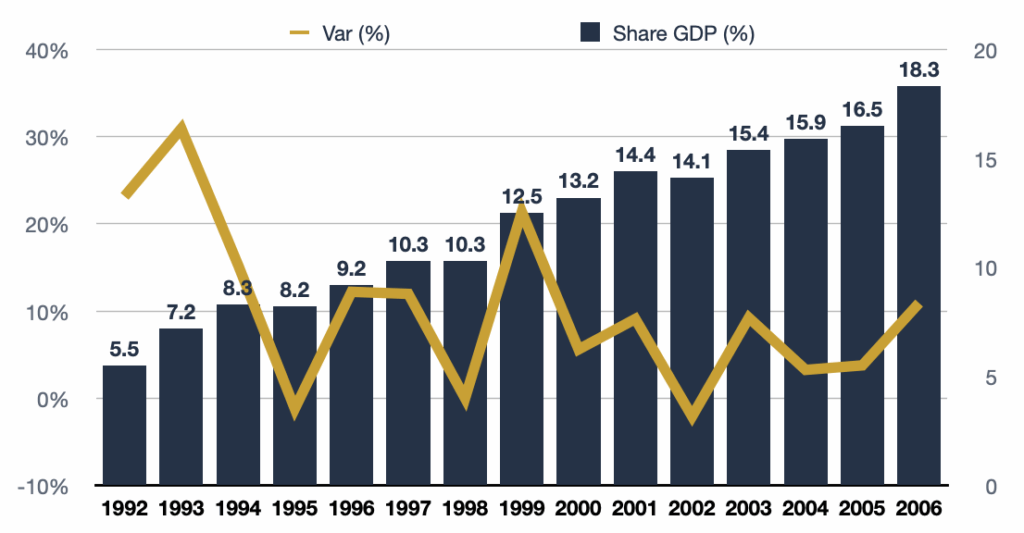
The sector’s progress also reflected favorable demographic and macroeconomic trends. Examples include population aging, rising life expectancy, growth in formal employment, and economic stabilization following the Real Plan. Together, these elements created a solid base for the expansion of complementary pensions.
The aim of this study is to identify the main economic, socio-demographic, and structural variables linked to the growth of pension funds in Brazil. The analysis combines a review of existing literature with statistical and time-series methods. The findings are intended to help policymakers, regulators, and industry leaders make informed decisions. By understanding these drivers, the sector can strengthen its role as a complement to public pensions and as a pillar for long-term capital formation in Brazil.
2. Key Variables Influencing Closed Pension Fund Growth
The factors driving the expansion of Brazil’s closed pension funds can be grouped into three main categories: structural, economic, and socio-demographic. This classification offers a balanced framework that links the operational characteristics of the sector to broader economic and social trends. By separating the variables into these groups, it becomes easier to understand how each dimension contributes to overall growth.
Structural variables describe the organization and internal functioning of the sector. They include the number of Closed Private Pension Entities (EFPCs), sponsoring organizations, pension revenues, participant numbers, and administrative expenses. Together, these indicators reflect the sector’s institutional capacity and operational efficiency. Changes in these variables often result from regulatory reforms, improvements in governance, and the adoption of more professional management practices.
Economic variables capture the financial and macroeconomic environment in which pension funds operate. This group includes GDP per capita, real wage growth, interest rates, the INSS benefit ceiling, and the minimum wage. These indicators influence the ability of individuals and companies to contribute to pension plans, as well as the returns on fund investments. Economic stability and income growth tend to support higher contributions, while interest rates and benefit ceilings affect both the attractiveness and the affordability of private pension plans.
Socio-demographic variables reflect long-term changes in the population and workforce. They include educational attainment, the average age of formally employed workers, growth in formal employment, and average job tenure. These factors influence participation rates and contribution patterns. For example, higher education levels and longer job tenure can lead to greater financial awareness and stronger engagement with pension plans, while demographic shifts such as population aging increase the relevance of private retirement savings.
Figure 2. Categories and Variables
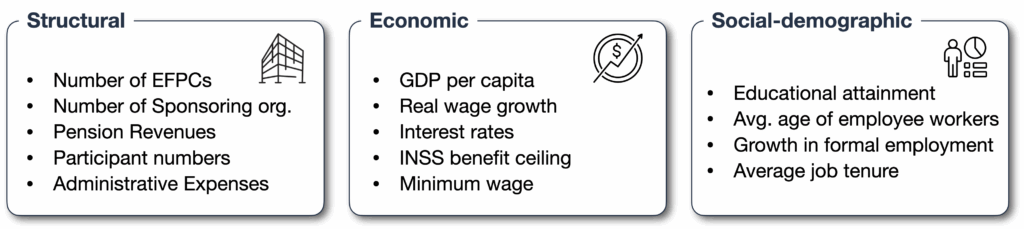
By analyzing these three groups of variables together, it becomes possible to identify patterns and interactions that might be overlooked when focusing on each factor in isolation. This integrated approach helps capture the complexity of pension fund growth and offers a more comprehensive view of the sector’s development.
3. Analytical Approach and Model Design
To assess how structural, economic, and socio-demographic variables influenced the growth of closed pension funds in Brazil between 1992 and 2006, the study estimated two complementary statistical models. The use of two models made it possible to first capture the full range of potential influences and then focus on the most relevant drivers while maintaining a balanced representation of all variable categories.
- Unrestricted Model (1) included all identified variables across the three categories. This broad specification provided an initial view of the complete set of possible explanatory factors, without imposing constraints on variable selection.
- Restricted Model (2) was developed by applying stepwise selection methods to retain only the variables with the strongest and most consistent statistical significance. In addition, this model applied a constraint to ensure that at least one variable from each category—structural, economic, and socio-demographic—remained in the equation.
This two-stage modeling approach offered both breadth and focus, enabling the analysis to identify the most influential variables while preserving the diversity of factors shaping pension fund growth.
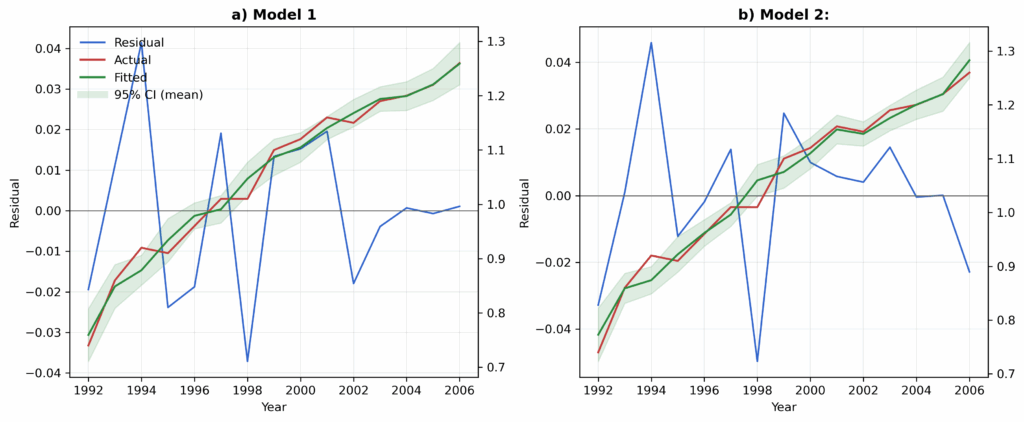
The performance of both models was evaluated through diagnostic checks, including residual analysis and goodness-of-fit measures. These tests confirmed that the models captured the main historical trends with a high degree of reliability. Figure 3 show how the actual growth of pension funds compares with the values predicted by each model, along with 95% confidence intervals. The close alignment between observed and predicted values highlights the models’ ability to explain the sector’s evolution during the study period.
Figure 3. Model Residuals, Actual, and Fitted Values (+95% CI) for Pension Fund Growth Models
4. Key Findings
The analysis indicates that both economic and socio-demographic factors played a central role in driving the growth of closed pension funds in Brazil. Economic conditions—such as stable inflation, rising wages, and supportive interest rate trends—created a favorable environment for long-term savings. Socio-demographic shifts, including higher educational attainment, an expanding formal labor market, and longer job tenure, further strengthened participation in pension plans.
Structural reforms complemented these trends. Improvements in governance practices, regulatory updates, and a broader range of investment opportunities enhanced the sector’s capacity to manage resources effectively and attract new participants.
Taken together, the results suggest that sustaining macroeconomic stability, encouraging formal employment, and maintaining a strong institutional framework are essential for the continued expansion of pension funds in Brazil.
5. Conclusion
Private pension funds hold a growing place in Brazil’s financial system. Understanding the factors that shape their expansion helps policymakers, regulators, and industry leaders design strategies that widen coverage, boost contributions, and reinforce their role as long-term capital providers.
Sustained progress will depend on strong governance, transparent operations, and the ability to adapt to economic and demographic changes. By maintaining these priorities, Brazil’s pension fund sector can continue to support national economic development while aligning with international best practices.
6. References
ABRAPP (2006), Informe Estatístico, vários números.
Matheus, A. A. (2008). Análise da Elasticidade das Variáveis Econômicas, Sócio-Demográficas e Estruturais sobre o Crescimento dos Fundos de Pensão no Brasil. Fundação Getúlio Vargas. Available at: https://repositorio.fgv.br/items/838ef8b7-0743-48e9-9699-6cfbfebd6294
OECD (2007). “Pension Markets in Focus” available at: http://www.oecd.org
Secretaria de previdência Complementar – SPC (2006). Entidades Fechadas de Previdência Privada – Informações Básicas (vários números), Brasília: DF.