
1. Introduction
The finance function within corporations is undergoing a profound transformation, transitioning from traditional transactional roles toward strategic business partnership roles (Accenture, 2022). This evolution is driven primarily by advancements in technology and automation, and by increased capacity for data-driven decision-making (Kabell, 2024). Central to this transformation is Finance 4.0, characterized by the adoption of digital tools and techniques that streamline routine tasks, freeing finance teams to focus on value-added analysis, insightful forecasting, and strategic influence (Corson, 2017).
Automating repetitive back-office processes and integrating advanced analytics allows finance professionals to proactively contribute to strategic initiatives, offer real-time insights, and effectively shape organizational decision-making (Deloitte, 2023). This strategic shift enhances agility, accuracy, and competitiveness in modern businesses (Mckinsey, 2021).
Understanding Finance 4.0 is crucial for finance functions that aspire to adopt a more strategic approach. By mapping out opportunities and overcoming challenges, they can solidify their position as key players within corporations, ensuring a smooth transition into a modern strategic finance landscape. Nevertheless, considering a more practical business perspective, Finance 4.0 by itself is not the underlying reason for the Finance transformation or the key aspect that makes a Finance department a Strategic partner to the business. The financial capabilities rooted in microfoundations ensure the transition and sustained strategic value-added with Finance 4.0 as an essential set of tools.
2. The Pillars of Finance 4.0
While Finance 4.0 is a relatively new concept (Kabell, 2024), its essence aligns closely with the broader fourth industrial revolution, anchored by four critical pillars:
- Automation and Robotics (RPA): streamlining repetitive tasks like accounting entries, reconciliations, and standard reporting using Robotic Process Automation (RPA).
- Advanced Analytics and AI: employing predictive analytics, machine learning, and AI to forecast financial trends, manage risk, and uncover deeper insights into financial performance.
- Cloud-Based Platforms: transitioning financial systems to cloud solutions for enhanced scalability, security, and real-time collaboration among global teams.
- Blockchain and Distributed Ledger Technologies: increasing transparency, accuracy, and security in financial transactions, particularly relevant for international payments, smart contracts, and auditing.
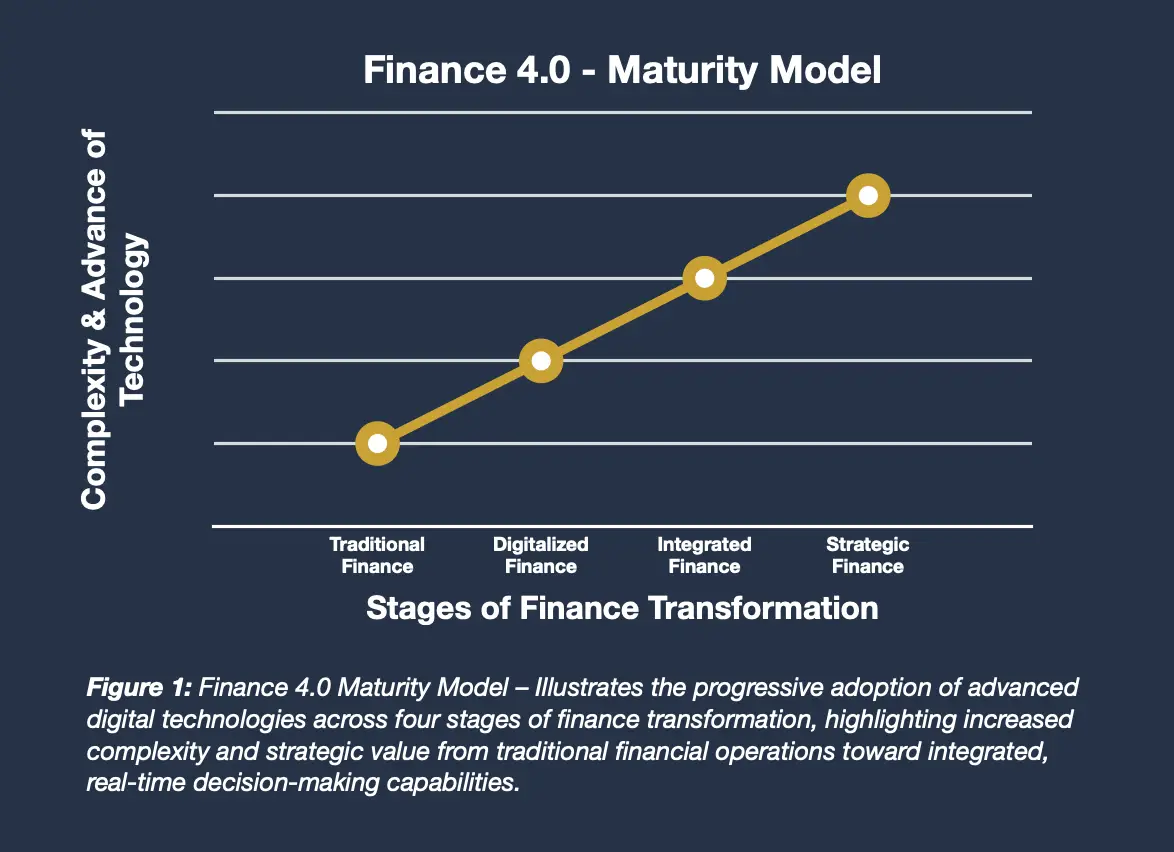
Finance 4.0 lies at the core of modern finance departments, as it creates the conditions to enhance productivity by speeding up repetitive operational tasks and freeing up time for professionals to focus on analysis rather than information processing. Depending on the transition stage of each company, the application of Finance 4.0 resources becomes more advanced and complex (George, 2024).
From this technological perspective, it’s possible to derive a Finance 4.0 maturity model, where the stages illustrate the progressive complexity and adoption of advanced technologies, emphasizing how companies evolve from traditional finance functions towards strategic partnerships driven by digital transformation. The Finance 4.0 Maturity Model is illustrated in Figure 1.
3. Benefits for Corporate Finance
The underlying interest in adopting Finance 4.0 is to leverage the transition of finance departments towards automation and digitalization, enabling them to act as true business partners and provide timely, value-added information for decision-making. Successful adoption of Finance 4.0 strategies provides significant advantages:
- Improved Accuracy and Compliance: Automation reduces manual errors and ensures consistent adherence to regulatory standards.
- Enhanced Strategic Decision-Making: Real-time data and predictive analytics empower CFOs and finance teams to make informed, agile decisions.
- Cost and Time Efficiency: Reducing operational costs through automation and enabling teams to focus on strategic initiatives.
- Scalability and Flexibility: Cloud-based platforms provide the flexibility needed to quickly adapt to changing business environments.
4. Challenges and Considerations
Transitioning to Finance 4.0 is complex and involves several significant challenges. According to McKinsey (2023), ERP systems constitute the essential infrastructure for Finance 4.0 but entail substantial implementation and maintenance costs. Early investment in robust data security is also critical during the initial stages of digital transformation, underscoring that Finance 4.0 initiatives require significant financial commitment.
The pace and success of this transition depend greatly on industry dynamics, market conditions, and organizational priorities. Companies must carefully evaluate and strategically align technological investments with their objectives. Additionally, constant adaptation and reassessment are necessary due to dynamic market conditions. Organizations must also revise established processes and responsibilities while managing the necessary cultural shift by developing new employee capabilities and addressing potential resistance to change (McKinsey, 2018). Traditional mindsets and behaviors are among the most common factors slowing finance transformation. (EY, 2024).
In summary, the primary challenges associated with Finance 4.0 transitions can be grouped into three key areas:
- Integration Complexity: Legacy systems can complicate the seamless integration of digital technologies.
- Data Security Concerns: Transitioning to digital platforms demands robust cybersecurity measures to protect sensitive financial data.
- Cultural Shift and Skill Gap: Employees may resist changes due to fear of job displacement, requiring comprehensive change management and upskilling initiatives.
5. Practical Steps and Recommendations
To successfully navigate the Finance 4.0 journey, organizations should consider these practical steps:
- Assess Current Capabilities: Evaluate existing processes and technology infrastructure. A global manufacturing firm performed a comprehensive gap analysis, revealing its heavy reliance on manual spreadsheet processes for month-end reporting. This highlighted the need to prioritize automated reporting tools.
- Prioritize Investments: Identify and prioritize technology investments that offer the highest strategic value. A multinational consumer goods company ranked its Finance 4.0 investments, prioritizing cloud-based ERP implementation over blockchain technology initially, due to immediate scalability needs and significant cost efficiencies.
- Develop a Clear Roadmap: Establish a detailed transition plan with clear milestones and objectives. A regional bank created a phased, 24-month roadmap for implementing advanced analytics, clearly defining quarterly milestones, such as launching initial predictive models within the first 6 months and expanding into AI-driven risk management within 18 months.
- Invest in Skills Development: Provide targeted training and support to bridge capability gaps. A large pharmaceutical corporation launched a targeted training program on data analytics and visualization tools for its finance team, significantly improving employee confidence and enabling smoother adoption of new technologies.
- Establish Robust Governance: Ensure clear roles and responsibilities to facilitate smooth integration and cultural adaptation. A technology services provider set up a dedicated digital finance committee, clearly defining roles and accountability for managing digital transformation, resolving integration challenges swiftly, and ensuring compliance with new security protocols.
6. Conclusion
Finance 4.0 is more than a mere technological advancement; it is a strategic imperative that transforms finance departments into essential drivers of organizational value. Companies that proactively embrace these digital transformations significantly strengthen their ability to navigate complex financial environments, ensure sustainable growth, and secure lasting competitive advantages. The Finance 4.0 maturity model presented here offers a practical framework that enables corporations to clearly assess and benchmark their current capabilities, strategically plan future initiatives, and proactively address potential challenges and roadblocks inherent in digital transformation journeys. Ultimately, the successful adoption of Finance 4.0 not only enhances operational excellence but positions finance functions as pivotal strategic partners within their organizations.
7. References
Accenture (2025). “CFO Now: Breakthrough Speed for Breakout Value.” Available at: https://www.accenture.com/content/dam/accenture/final/a-com-migration/pdf/pdf-145/accenture-cfo-now-research-2021-fullreport.pdf
Accenture (2022). “CFO Reimagined: From Driving Value to Building the Digital Enterprise.” Available at: https://www.accenture.com/us-en/insights/consulting/cfo-reimagined
Deloitte Insights (2023). “Finance 2025: Digital Transformation in Finance.” Available at: https://www2.deloitte.com/global/en/pages/finance-transformation/articles/finance-2025.html
EY (2022). “How Corporate Finance is Evolving in the Digital Age.” Available at: https://www.ey.com/en_gl/cfo-agenda/how-corporate-finance-is-evolving-in-the-digital-age
EY (2024). “Unleashing the power of technology to transform finance”. Available at: https://www.ey.com/en_us/services/consulting/finance-consulting-services/harnessing-technology-to-revolutionize-finance
Gartner (2023). “The CFO’s Roadmap to Digital Transformation.” Available at: https://www.gartner.com/en/finance/insights/the-cfos-roadmap-to-digital-transformation
George, A. S. (2024). “Finance 4.0: The Transformation of Financial Services in the Digital Age.” ResearchGate. Available at: https://www.researchgate.net/publication/381434460_Finance_40_The_Transformation_of_Financial_Services_in_the_Digital_Age
Kabell, P.; Worm, L. (2024). “The Future of Finance: Unpacking the Impact of Finance 4.0.” Copenhagen Business School. Available at: https://research.cbs.dk/da/studentProjects/the-future-of-finance-unpacking-the-impact-of-finance-40
McKinsey & Company (2021). “Digital Strategy in Corporate Finance: From Operational to Strategic Excellence.” Available at: https://www.mckinsey.com/capabilities/strategy-and-corporate-finance/our-insights/digital-strategy-in-corporate-finance-from-operational-to-strategic-excellence