
Abstract
In today’s fast-paced business landscape, finance departments are increasingly expected to transcend traditional reporting functions and evolve into strategic business partners. This article explores how automation technologies—such as Robotic Process Automation (RPA), Python-based analytics, and Business Intelligence (BI) platforms—are reshaping the finance function. Drawing on theoretical frameworks in strategic management, including the Resource-Based View and Dynamic Strategic Fit, the paper posits that automation is not merely a tool for enhancing operational efficiency; it is a crucial enabler of superior organizational performance. Through a comprehensive review of contemporary literature and practical examples, this study investigates how automation boosts decision-making capabilities, fosters sustained competitive advantage, and addresses the necessary cultural, behavioral, and structural adjustments required for successful implementation.
1. Introduction
Historically, the finance function has operated as a reactive, transaction-oriented department, primarily focused on historical reporting and regulatory compliance. However, finance teams, particularly in emerging markets, are increasingly confronted with additional challenges such as currency volatility, inconsistent data availability, and rapidly evolving regulatory frameworks. These external pressures not only demand more agile and forward-looking financial practices but also underscore the imperative for finance to develop into a strategic partner within the organization.
To navigate this shifting landscape and drive strategic transformation, finance departments must adopt automation technologies that deliver real-time insights, reduce manual processing, and enable data-driven decision-making (Deloitte, 2023). Furthermore, evolving market volatility, regulatory complexities, and heightened stakeholder expectations have intensified the demand for forward-looking analysis. Automation has emerged as a pivotal enabler in this transformation, empowering finance professionals to move beyond operational tasks and contribute to high-level strategic initiatives (Accenture, 2022).
2. Theoretical Foundations: Automation and Decision-Making
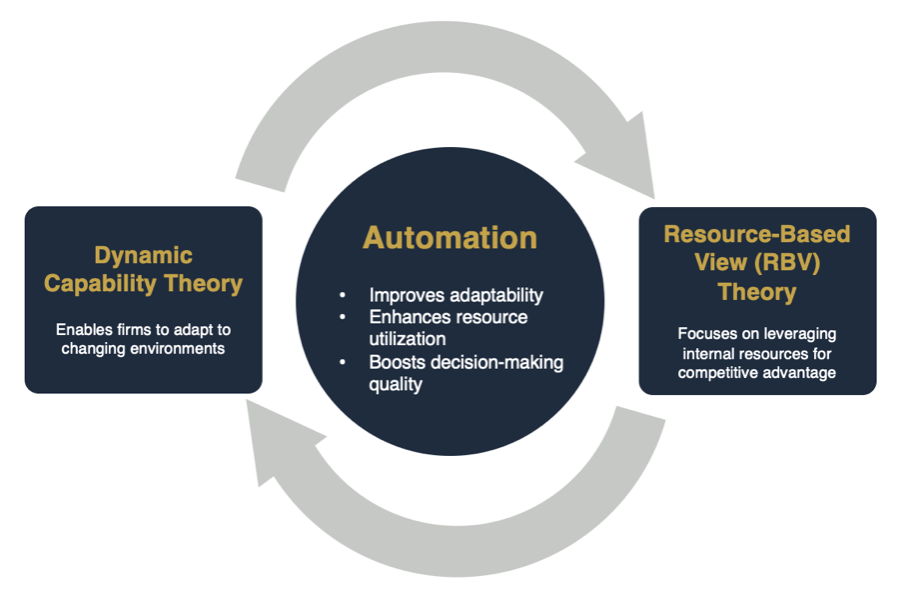
From a strategic management perspective, the shift toward automation in finance can be examined through two complementary theoretical lenses: the Dynamic Strategic Fit theory and the Resource-Based View (RBV).
The Dynamic Strategic Fit framework (Zajac et al., 2000) emphasizes that organizations must continuously realign their internal capabilities with external environmental conditions to maintain strategic coherence. In the context of finance, this implies that automation is not merely a technological upgrade but a necessary adaptation to evolving market dynamics, regulatory pressures, and stakeholder expectations. Teece et al. (1997) further argue that dynamic capabilities are critical for sustaining competitive advantage in turbulent environments by enabling firms to integrate, build, and reconfigure internal competencies.
Complementarily, the RBV posits that sustainable competitive advantage is derived from the development and strategic deployment of valuable, rare, inimitable, and non-substitutable (VRIN) resources (Barney, 1991; Peteraf, 1993). Digital competencies, such as advanced analytics, automated workflows, and real-time reporting infrastructures, represent such resources when effectively integrated into finance functions (De Montreuil Carmona, 2023; Kero & Bogale, 2023).
While much of the RBV and DC literature emphasizes technology as a source of external competitive differentiation, in the finance function, automation plays a foundational enabling role, enhancing internal accuracy, speed, and capacity. This internal optimization, in turn, allows finance professionals to reallocate time and attention to high-impact strategic tasks that support long-term organizational objectives and value creation (Fainshmidt et al., 2019).
Together, these theories provide a comprehensive foundation: automation is not only a tool for operational efficiency but a strategic enabler that positions finance functions to anticipate and respond to change while maximizing internal capabilities.
From this strategic foundation, the quality of decision-making in corporate finance can be further understood to be influenced by three core variables: data timeliness, data reliability, and analytical depth (Gartner, 2023). Automation directly enhances these dimensions by reducing cycle times, minimizing human error, and enabling analysis of complex scenarios. According to the Chartered Institute of Management Accountants (CIMA, 2022), automating routine tasks such as data gathering and reporting frees up finance professionals to focus on strategic analysis and business partnering. Further, AICPA and CIMA (2024) found that organizations leveraging automation and analytics are significantly better equipped to support long-term strategic planning, ESG reporting, and agile decision-making.
3. Mechanisms Through Which Automation Enhances Strategic Decision-Making
3.1 Operational Efficiency and Capacity Reallocation:
Automation significantly reduces the time spent on manual, repetitive tasks such as data consolidation, reconciliations, and variance analysis (EY, 2022). This efficiency gain enables finance teams to reallocate resources towards higher-value activities such as strategic planning and business partnering (PwC, 2023).
3.2 Data Quality and Reliability Improvement:
Automated data pipelines enhance accuracy by reducing the risk of manual input errors (KPMG, 2021). This improvement in data reliability serves as a foundation for more confident decision-making.
3.3 Real-Time and Predictive Analytics Enablement:
With the integration of Python-based forecasting models and BI tools like Power BI and Tableau, finance teams can conduct real-time scenario modeling and predictive forecasting. This allows for proactive risk mitigation and opportunity identification (Accenture, 2022).
4. Empirical Evidence: Case Illustrations
- Forecasting Accuracy Enhancement in Consumer Goods: A multinational consumer goods company implemented automated forecasting using Python’s scikit-learn library, reducing forecast error margins by 18% over two quarters (PwC, 2023).
- Liquidity Risk Management in Manufacturing: An industrial firm automated its cash flow projections, integrating data from multiple ERPs, which improved its working capital management by reducing forecasting time by 30% (KPMG, 2021).
- Scenario Planning in Healthcare: A healthcare organization leveraged RPA and BI tools to model multiple budgetary scenarios, enabling faster resource allocation during periods of operational stress (EY, 2022).
5. Organizational, Cultural, and Behavioral Considerations
The successful deployment of automation is not solely a technological challenge but also a deeply cultural and organizational one (Schein, 2010). As automation transforms the nature of work in finance, it demands a substantial shift in both hard and soft skills, compelling organizations to foster a culture of continuous learning, adaptability, and resilience.
According to the World Economic Forum’s Future of Jobs Report 2025, 39% of workers’ current skill sets are expected to be disrupted or rendered obsolete by 2030. Analytical thinking remains the most in-demand core skill, followed closely by resilience, agility, leadership, and technology literacy. Notably, 85% of employers plan to prioritize workforce upskilling, while 63% identify skill gaps as the primary barrier to business.
Within this landscape, finance teams must be equipped not only with technical proficiency in areas such as automation and data analytics but also with the strategic, collaborative, and adaptive capabilities necessary to thrive in a rapidly evolving digital environment.
Key considerations include:
- Cultural Transformation: A culture of continuous learning, experimentation, and data-driven thinking is essential for automation to thrive. Finance professionals must embrace a shift from process ownership to insight generation, and leaders must model adaptability by encouraging openness to change and innovation (Kotter, 1996; McKinsey & Company, 2018).
- Skills Evolution: Automation reshapes the talent profile within finance. While technical capabilities in areas such as data analytics, Python scripting, and BI tools become increasingly important, soft skills such as problem-solving, critical thinking, and strategic communication also gain prominence. Upskilling initiatives must be embedded into transformation roadmaps to avoid capability gaps that hinder adoption (Davenport & Kirby, 2016).
- Behavioral Shifts: Traditional mindsets centered on control, manual oversight, and task repetition may resist automation. Addressing this requires structured change management programs that clarify roles, set expectations, and recognize new forms of contribution, particularly analytical and advisory work.
- Governance and Data Stewardship: Automation heightens the importance of governance frameworks that ensure data quality, cybersecurity, and compliance. As data becomes more integrated and accessible, robust protocols must be established to manage access, integrity, and ethical usage (KPMG, 2021; AICPA & CIMA, 2024).
In sum, automation success hinges not only on digital tools but on aligning people, mindsets, and governance structures. A holistic transformation approach—where culture, behavior, and capability development are prioritized—is critical for realizing the strategic benefits of automation in finance.
6. Conclusion
In an era characterized by rapid technological disruption, regulatory complexity, and evolving stakeholder expectations, organizations must continuously adapt to ensure strategic alignment with external market dynamics. Strategic management frameworks, such as Dynamic Strategic Fit and the Resource-Based View, highlight that sustainable competitive advantage is achieved not only through reactive adaptation but also through the intentional alignment of internal capabilities with changing environmental demands.
Within this broader organizational landscape, automation emerges as a crucial enabler, enhancing the finance function’s capacity to drive strategic agility. By streamlining operational processes, enhancing data reliability, and facilitating advanced analytics, automation frees finance professionals to concentrate on high-impact activities, including scenario planning, risk assessment, and strategic advising.
When viewed holistically, automation in finance is not an end in itself but rather a vital connector between macro-level strategic responsiveness and micro-level execution. It bolsters internal capabilities, promotes decision-making agility, and positions the finance function as a key orchestrator in steering the organization toward superior market performance. To fully harness this potential, however, companies must embrace not only the technology but also the cultural, structural, and behavioral changes necessary to embed automation as a sustained strategic advantage.
7. References
Accenture. (2022). CFO reimagined: From driving value to building the digital enterprise. Accenture. https://insuranceblog.accenture.com/wp-content/uploads/2018/10/Accenture-CFO-Research-Global.pdf
AICPA & CIMA. (2024). Re-defining Finance for a Sustainable World. https://www.aicpa-cima.com/news/article/new-aicpa-and-cima-research-shows-deep-divide-among-finance-professionals
Barney, J. (1991). Firm resources and sustained competitive advantage. Journal of Management, 17(1), 99–120. https://doi.org/https://doi.org/10.1177/014920639101700108
Davenport, T. H., & Kirby, J. (2016). Only humans need apply: Winners and losers in the age of smart machines. Harper Business.
De Montreuil Carmona, L. J. (2023). Analyzing the path of Resource-based and Dynamic Capabilities Theories for explaining the differentiated performance of firms. Revista De Negócios, 27(4), 107–125. https://doi.org/10.7867/1980-4431.2022v27n4p107-125
Deloitte. (2023). Finance 2025: Looking ahead with the benefit of hindsight. Deloitte. https://www2.deloitte.com/content/dam/Deloitte/us/Documents/finance/us-cfo-insights-finance-2025-looking-ahead-with-the-benefit-of-hindsight-v2.pdf
EY. (2022). How corporate finance is evolving in the digital age. EY. https://www.ey.com/en_gl/cfo-agenda/how-corporate-finance-is-evolving-in-the-digital-age
Fainshmidt, S., Wenger, L., Pezeshkan, A. and Mallon, M.R. (2019), When do Dynamic Capabilities Lead to Competitive Advantage? The Importance of Strategic Fit. J. Manage. Stud., 56: 758-787. https://doi.org/10.1111/joms.12415
Gartner. (2023). The CFO’s roadmap to digital transformation. Gartner. https://www.gartner.com/en/finance/insights/the-cfos-roadmap-to-digital-transformation
Kero, C.A., Bogale, A.T. (2023). A systematic review of resource-based view and dynamic capabilities of firms and future research avenues. International Journal of Sustainable Development and Planning, Vol. 18, No. 10, pp. 3137-3154. https://doi.org/10.18280/ijsdp.181016
KPMG. (2021). Automation and finance transformation: Building data confidence. KPMG. https://home.kpmg/xx/en/home/insights/2021/05/automation-and-finance-transformation.html
Kotter, J. P. (1996). Leading change. Harvard Business Press.
McKinsey & Company. (2018). The behavioral science of organizational change. McKinsey & Company. https://www.mckinsey.com
McKinsey & Company. (2021). Digital strategy in corporate finance: From operational to strategic excellence. McKinsey & Company. https://www.mckinsey.com/capabilities/strategy-and-corporate-finance/our-insights/digital-strategy-in-corporate-finance-from-operational-to-strategic-excellence
Peteraf, M. A. (1993). The cornerstones of competitive advantage: A resource-based view. Strategic Management Journal, 14(3), 179–191. https://www.jstor.org/stable/2486921
PwC. (2023). Finance effectiveness benchmark report. PwC. https://www.pwc.com/gx/en/services/finance-effectiveness.html
Schein, E. H. (2010). Organizational culture and leadership (4th ed.). Jossey-Bass.
Teece, D. J., Pisano, G., & Shuen, A. (1997). Dynamic capabilities and strategic management. Strategic Management Journal, 18(7), 509–533. https://www.jstor.org/stable/3088148
Verbeeten, F. H.M. and Bedford, D. S., Derichs, D., Hoozée, S., Malmi, T., Messner, M., Sinha, VK, van der Kolk, B. (2025). Digitalization of the finance function: Automation, analytics, and finance function effectiveness. Management Accounting Research 67 (2025) 100942. http://dx.doi.org/10.2139/ssrn.4812512
World Economic Forum. (2025). The future of jobs report 2025. https://www.weforum.org/publications/the-future-of-jobs-report-2025/
Zajac, E. J., Kraatz, M. S., & Bresser, R. K. F. (2000). Modeling the dynamics of strategic fit: A normative approach to strategic change. Strategic Management Journal, 21(4), 429–453. https://doi.org/10.1002/(SICI)1097-0266(200004)21:4<429::AID-SMJ81>3.0.CO;2-5